- You are here:
- Home »
- Airbrush Cleaning »
- Deep Clean Your Gravity Feed Airbrush
Deep Clean Your Gravity Feed Airbrush
Why should you deep clean your gravity feed airbrush?
- It’s just like sending your airbrush off for a factory overhaul.
- It’s easy. Well, maybe not the first time through.
- Deep cleaning your airbrush is far faster than sending it back to the factory–unless, of course, you’re right next door…
- When other cleaning methods fail to resolve a problem, a deep cleaning is the next, and usually the last troubleshooting step.
This particular guide applies to these airbrush models.
Iwata
| HP-A | HP-A+ | HP-AH | HP-AR |
| HP-B | HP-B+ | HP-BH | HP-BR |
| HP-C | HP-C+ | HP-CH | HP-CR |
| K-CH |
If you manufacture or import airbrushes and think your brand and model should be included in this list, please contact me.
The Guru’s Tips for Your First Time Through This Guide
-
Set aside an hour.
A good, thorough, deep cleaning might only last five minutes if you know what you’re doing. But this is your first time through. There’s new terminology, it might be your first time taking the airbrush apart, for whatever reasons, set aside the time. It will probably take far less to finish but that’s okay because…
-
Take your time.
The first time through this guide you might get a little confused. It’s okay. Figure out what’s going on and keep on moving, because you’ll also need to…
-
Be Thorough
By, “Be Thorough” I mean be an obessive compulsive clean freak. People who are a touch OC do airbrush maintenance very well. 😉
I tell people to clean their airbrushes a second and even a third time because I understand the difference between what most people think a clean airbrush is and what a clean airbrush really is.
It took me three hours and 4 “do-overs” to get my first airbrush clean. Kirk and Gary wanted me to know what a clean airbrush really is.
-
Frustration Happens
Get up. Walk away. Go do something else. Bad Things happen to airbrushes when you’re frustrated. Trust me, I still get frustrated. As soon as I realize it I go take a break.
Come back with a fresh mind and attitude. Don’t worry, you’ll get it, but if not…
-
Call Up Tech Support
Airbrush importers and manufacturers want you to succeed. Most of them have technical support lines to help you work through whatever problem you’re facing.
The Guru’s Tips For Everyone
-
Needles are Sharp!
They hurt going in and if they hit bone they hurt even more coming back out–don’t ask me how I know that…
That means…
If the needle drops to the floor DON’T CATCH IT WITH YOUR HANDS OR LEGS! You can learn the lesson from my warning or by finding out for yourself…
-
Nozzles are Delicate
Be gentle. After cleaning, the second most common airbrush problem is nozzle damage. The most likely time to damage that nozzle–is now.
-
Only Clean Places Paint Goes
Bottles, cups, the outside, and the paint passage are all you need to worry about without a specific reason. Cleaning out other areas, like the trigger housing or the air valve can result in a few unexpected problems.
Instructions
Equipment
- Towel or tray to work overTo catch things that drop. Small pieces are really good at hiding.
- Appropriate cleaning solutionGenerally it’s your paint’s reducer, or ‘base’. Alcohol based paints tend to dissolve in alcohol, water-based paints in water, etc. Sometimes, especially for water-based paints, there are other cleaning solutions that work much, much better than just plain water. Don’t use anything with ammonia in it.
- Round wooden or bamboo toothpicksYou might need some sand paper or an old nail file here as well depending on just how sharp the toothpicks are–you might need to make them sharper.
- Bristled cleaning brush or….Interdental brushes (personal favorite), Airbrush cleaning brushes (you’ll need the small ones), or pipe cleaners (not recommended)
- The wrench that came with the airbrush
- Cotton swabs for general cleaningNote: Cotton swabs do occasionally shed their fibers, if it does just make sure you pick them out
- Mirror or mirror-like surfaceOld AOL CDs are my favorite “mirror-like surface” but if you’re cleaning with a solvent CDs won’t last long. In that case use part of a glass mirror.
- (Optional) magnifying glass or jeweler’s loupe
Disassembly
- Unscrew the handle

- Unscrew the needle chucking nut
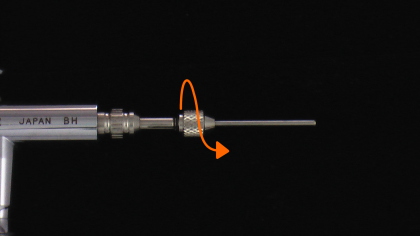
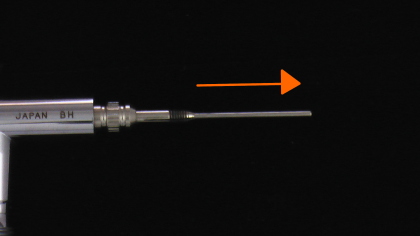
- Pull out the needle
- Clean the needle with a rag…
 … or with a cotton swab.
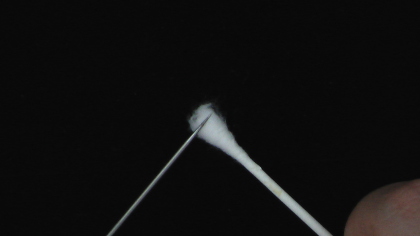
- Warning: Needles are still sharp.
- Unscrew the needle cap

- Unscrew the nozzle cap

- Unscrew the nozzle counter-clockwise with the wrench

Caution: Nozzles are delicate, they break easily
Cleaning
- Examine the nozzle for damage
- Look at the small tip
- Make sure it’s a true, perfect circle free of dings, dents, tears, and cracks

- Look at the nozzle from the side
- Make sure the tip does not flare out like a trumpet
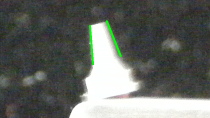
- If the nozzle does not pass inspection replace it
- Clean the nozzle with a toothpick

This is the important piece, make extra special certain it’s clean. You might need to sharpen the toothpick with some sandpaper or an old nail file. - Clean the paint passage with the cleaning brush
- That’s everything between the stem the nozzle screws into…
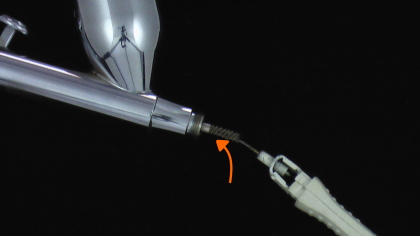
- To the front of color cup.

- That’s everything between the stem the nozzle screws into…
- Clean the color cup. Cotton swabs or paper towels both work fine here.

NOTE: Clean everything very thoroughly! I know you’re getting tired of me saying it. But I harp on it because it really IS that important!
Reassembly
- Screw the nozzle into the airbrush body.
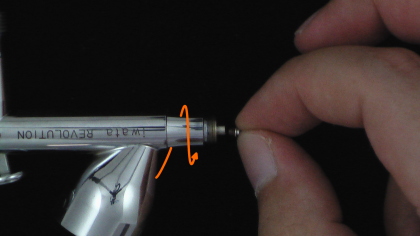
- Hold the nozzle in your fingers
- Twist the airbrush body onto it.
- Twist until finger tight.
- Tighten the nozzle with the wrench gently, no more than an eighth of a turn.
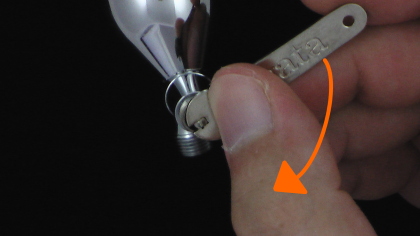
- CAUTION: This is the most likely time to damage the nozzle. Be careful.
- Screw the nozzle cap onto the airbrush body
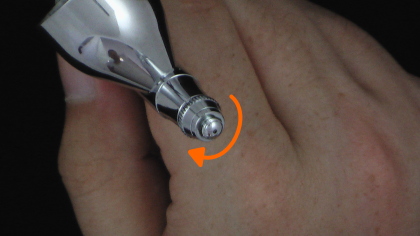
- Screw the needle cap onto the nozzle cap
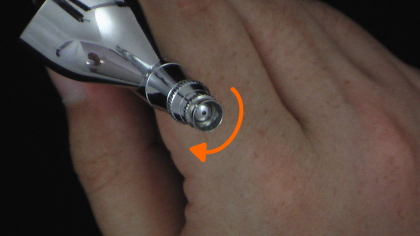
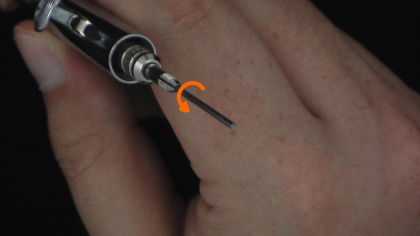
- Gently insert the needle. It should come to a firm stop with the needle tip poking out of the front.

Do not force it in. - Twist the needle counter-clockwise a quarter turn
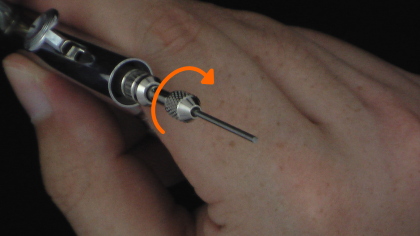
- Screw the needle chucking nut, big end first, onto the needle chucking guide
- Screw the handle onto the back of the airbrush body

Testing
- Fill the color cup with water
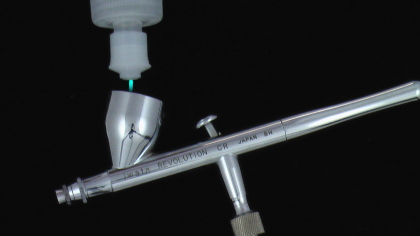
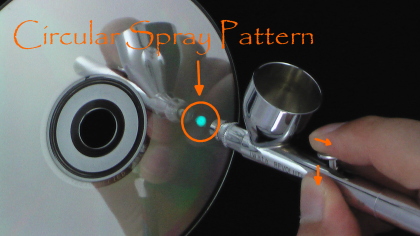
- Hold the airbrush up to a mirror and press down for air only
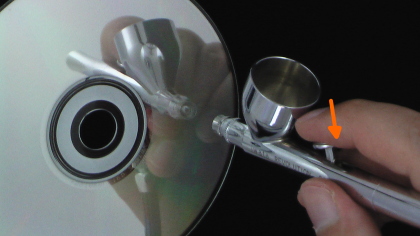
- No spray should come out.
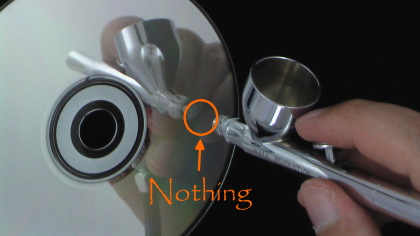
- Hold the airbrush away from the mirror.
- While holding the trigger down for air pull it all the way back.
- You should get lots of continuos spray

- Hold the airbrush back up to the mirror and re-confirm no spray

- Now pull the trigger back slightly
- You should get a round spray pattern.