
- You are here:
- Home »
- Airbrush Reviews »
- The Iwata Custom Micron Series
The Iwata Custom Micron Series
Iwata Custom Micron series has four models CM-B, CM-C, CM-C+, CM-SB
Review and Opinions:
- Custom Microns aren’t for everyone. They’re professional tools for masters, and aspiring masters.
- They get finicky and clog a lot if your paint consistency is off.
- Custom Microns are geared specifically toward fine details.A good workhorse airbrush will take you 93-97% of the way to incredible detail. The Custom Micron takes you the last 3-7%.
- They suck at anything other than fine details. Yes, they create spatter effects and spray a 1 inch wide spray pattern however less expensive options are available to do these effects.
- If you’re not experienced at paint mixing then buy airbrush-ready paint. You’ll still need to strain and thin the paint but it won’t be nearly as bad, and as frustrating as it could’ve been…
Matching Rules
- Desire or necessity for incredibly fine detail work.
- Prior airbrush experience required.Actively discourage beginners from purchasing Custom Micron airbrushes.
- Requires experience thinning and straining paint to reach the appropriate sprayable paint consistency.Custom Micorns only spray thin, non-viscous liquids. Otherwise they clog without hesitation.
- I usually fit someone to a CM-C or CM-C+ before a CM-SB unless they specifically want a side feed configuration.
The Iwata Custom Micron CM-B

- Part Number: ICM 2000,
- The smaller 1/16 oz cup is nice for people with big sausages for fingers.
Specifications
| Paint feed System: | Gravity Feed |
| Trigger Style: | Dual Action |
| Spray Type: | Internal Mix |
| Spray Range: | < 60 microns to ~1 inch |
| Cup Size: | 1/16 oz (1.8 ml) |
| Air Consumption: | < 0.2 cfm |
| Pressure Tolerance: | < 100 psi |
| Standard Tip Size: | 0.18 mm |
| Optional Tip Size: | 0.23 mm |
Links –Manufacturer’s Product Page, manual, parts and trobleshooting guide
The Iwata Custom Micron CM-C
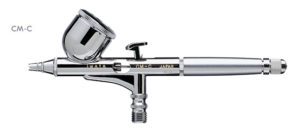
- Part Number: ICM 4000,
- I usually, by default, fit someone to a CM-C or CM-C+ when they’re interested in a Custom Micron.
- I like the big 1/3 oz cup, but sometimes i think it’s too big. My finger likes to run into it while I use the airbrush (but I do have big hands)
Specifications
| Paint feed System: | Gravity Feed |
| Trigger Style: | Dual Action |
| Spray Type: | Internal Mix |
| Spray Range: | < 60 microns to ~1 inch |
| Cup Size: | 1/3 oz (9 ml) |
| Air Consumption: | < 0.2 cfm |
| Pressure Tolerance: | < 100 psi |
| Standard Tip Size: | 0.23 mm |
| Optional Tip Size: | 0.18 mm |
Links –Custom Micron CM-C Manual, Parts and Troubleshooting guide
The Iwata Custom Micron CM-C Plus
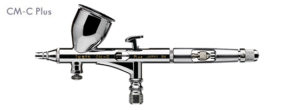
- Part Number: ICM 4500,
- The CM-C Plus is for people who want the Micro Air Control Valve, otherwise the CM-C will do just as well.
- I like the big 1/3 oz cup, but sometimes I think it’s too big. My finger likes to run into it while I use the airbrush (but I do have big hands)
- The cup got redesigned into a funnel. This is great for cleanup. It also reduces wasted paint by a few drops.
Specifications
| Paint feed System: | Gravity Feed |
| Trigger Style: | Dual Action |
| Spray Type: | Internal Mix |
| Spray Range: | < 60 microns to ~1 inch |
| Cup Size: | 1/3 oz (9 ml) |
| Air Consumption: | < 0.2 cfm |
| Pressure Tolerance: | < 100 psi |
| Standard Tip Size: | 0.23 mm |
| Optional Tip Size: | 0.18 mm |
Links –Custom Micron CM-C Plus Manual, Parts and Troubleshooting Guide
The Iwata Custom Micron CM-SB

- Part Number: ICM 3000,
- Side feed airbrushes can spray upside down. You can configure them with gravity cups, side feed cups, or bottles.
Specifications
| Paint feed System: | Side Feed |
| Trigger Style: | Dual Action |
| Spray Type: | Internal Mix |
| Spray Range: | < 60 microns to ~1 inch |
| Cup Size: | varies |
| Air Consumption: | < 0.2 cfm |
| Pressure Tolerance: | < 100 psi |
| Standard Tip Size: | 0.18 mm |
| Optional Tip Size: | 0.23 mm |
Links –Custom Micron CM-SB Manual, Parts and Troubleshooting Guide
Useful Accessories
- External Micro Air Control Valve
- Pistol Grip Moisture Filter
- Quick Disconnect
- Table Top Cleaning Station
Features
- Crown Cap
- Pre-set Handle
- Matched Head System
Custom Micron Cleaning Guides
- Custom Micron Easy Cleaning Tip
- Remove Tip Dry Approved Method
- Remove Tip Dry Un-Approved Method
- Rinse a Gravity Feed Airbrush Between Colors
- Rinse a Gravity Feed Airbrush After a Spray Session
- Deep Clean a Gravity Feed Airbrush with Screw in Nozzle
Outstanding/Common Problems
-
Tip Dry
If you’re using spray equipment and the needle is long and pointy, you WILL have tip dry. A slow reducer can help depending on the type of paint you spray. Otherwise, get good at knowing how to recognize and remove tip dry
-
Clogs
Custom Microns clog more than most airbrushes. It can seem like they clog when you simply bring chunky paint near them. Smaller nozzles and low air pressure do that to you.
-
Weak Nozzle
Custom Microns deal with the weak nozzle better than most airbrushes though. The head system can be removed to clean out the inside of the nozzle without removing the nozzle itself.
-
When the nozzle or nozzle cap dies the whole head system must be replaced to keep performance.
Matched head systems give great performance, the downside is that when they die you have to replace the whole head system. An added bonus to replacing the whole head is that you almost completely refurbish your airbrush to factory settings–well, everything except the trigger mechanism. You’ll have to clean and lube the air piston to make that feel like new.
-
Bent needles
It’s common, and it’s your fault. The good news is that you might try repairing the needle yourself. The bad news is that you should probably still order that replacement nozzle, especially if you’ve never tried repairing a needle before.
-
No teflon o-rings
On some levels this is good. Rubber or neoprene o-rings compress much, much better and are far more adjustable than teflon, which doesn’t really compress at all. If you use water or alcohol based paint the lack of teflon isn’t an issue. But if you use other, harsher paints their reducers eat non-teflon o-rings for a light snack if you’re not careful–well, the airbrush is setup in a manner that keeps the o-rings intact for extended use and the o-rings are technically solvent-resistant. But they will eventually wear away and need to be replaced.